
Your oven won’t heat up, and dinner isn’t going to cook itself – that sinking feeling when you set the temperature and nothing happens is one of the more frustrating moments in any kitchen. This guide walks you through the most common reasons an oven stops heating properly, what you can check yourself, and when it makes more sense to call in a professional. 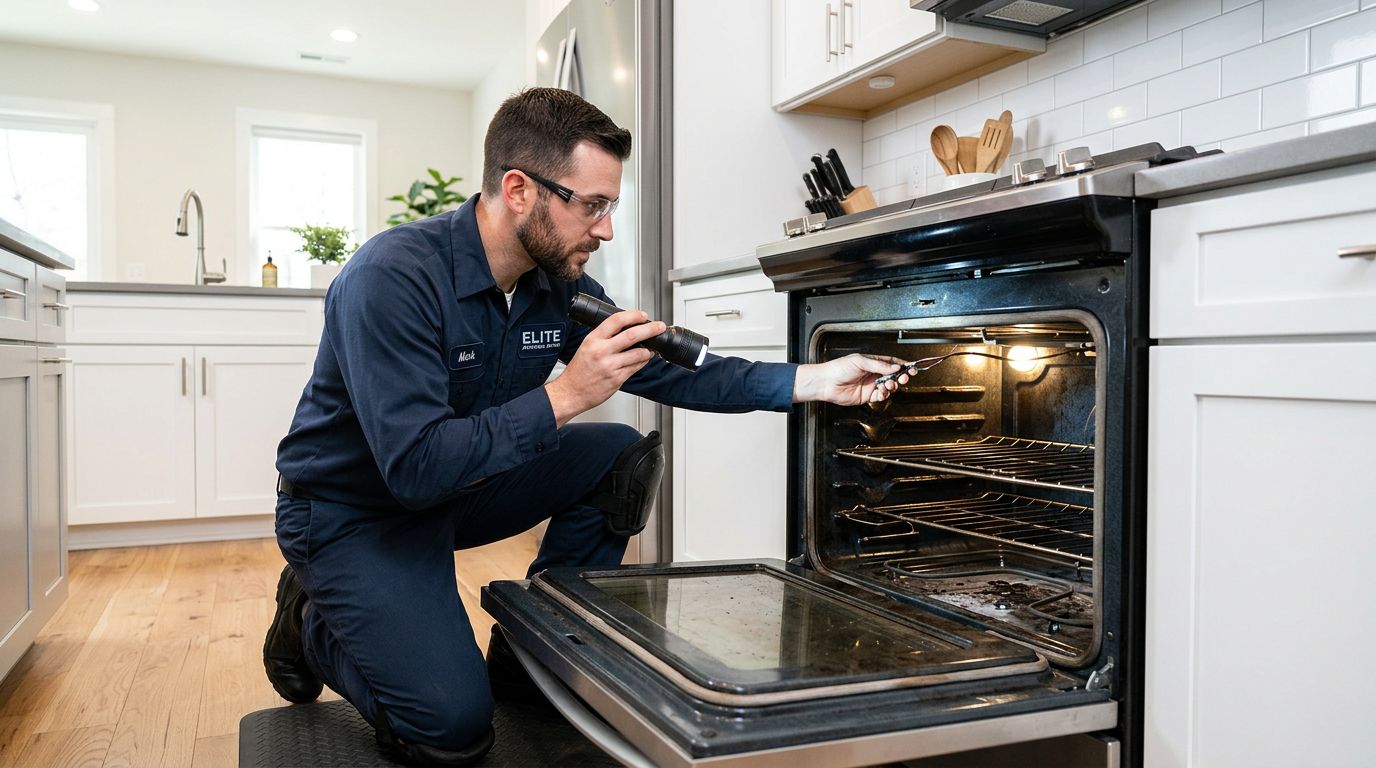 Ovens take a beating over the years. In Mission, where many homes were built in the 70s, 80s, and 90s, aging appliances are a common story – and the oven is often the last thing people think about until it stops working mid-roast. At Dewdney Appliance Repair, we get calls about oven not heating properly more than almost any other kitchen issue, and the good news is that many cases come down to a handful of fixable problems. Some you can handle yourself. Some you shouldn’t. The climate here doesn’t help. Moisture from the Fraser Valley can accelerate corrosion on older heating elements and wiring connections. If your oven has been acting up – taking longer to preheat, cooking unevenly, or just refusing to get hot at all – you’re in the right place.
Key takeaways
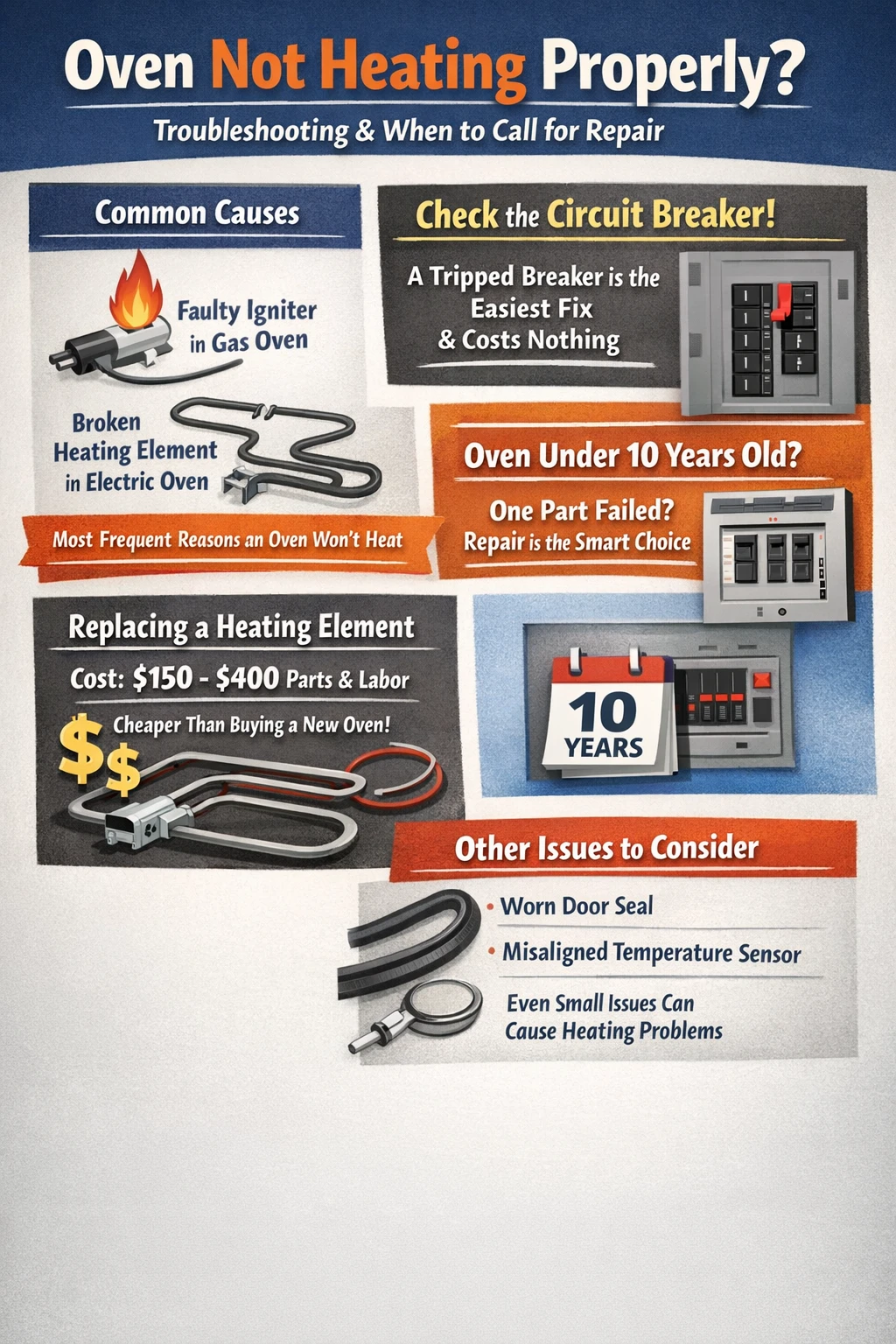
- A faulty igniter in gas ovens and a broken heating element in electric ovens are the two most common reasons an oven won’t heat up.
- Always check your circuit breaker first – a tripped breaker is the easiest fix and costs nothing.
- Replacing a heating element typically costs between $150 and $400 for parts and labor, which is almost always cheaper than buying a new unit.
- If your oven is under 10 years old and only one component has failed, repair almost always makes financial sense.
- Ovens last about 15 years on average – if yours is older and needs a major repair, replacement may be the smarter long-term investment.
- A failing door seal or mispositioned temperature sensor can cause heating problems even when the element and igniter are perfectly fine.
Why your oven isn’t heating – the short answer
When an electric oven won’t heat up, the bake element is the first suspect. It’s the component at the bottom of your oven cavity that glows red when working properly. If it doesn’t glow, or if you can see visible cracks, burns, or breaks on the element itself, it needs to be replaced. For gas ovens, a dirty or failed igniter is the usual culprit – without a working igniter, the gas can’t light and the oven stays cold. That said, the element and igniter aren’t the only possibilities. A tripped breaker, a bad outlet, a loose temperature sensor, or a worn door gasket can all cause oven temperature issues that look like a heating failure but have simpler fixes. The trick is working through them in the right order so you’re not replacing a $60 part when the real problem is a $0 breaker reset. We typically see electric oven heating problems split between failed elements and thermostat or sensor issues. Gas oven problems lean more toward the igniter, though gas supply and valve issues do come up. Knowing which type of oven you have matters a lot before you start troubleshooting.
Step-by-step troubleshooting for an oven not heating
First things first – before you open a panel or touch anything inside the oven, check the simple stuff. It sounds obvious, but you’d be surprised how often a tripped circuit breaker is the whole story.
Check the circuit breaker
Your oven runs on a dedicated 240-volt circuit. If that breaker tripped – sometimes it lands in the middle position rather than fully flipping to “off” – the oven loses power. Go to your breaker panel, find the oven breaker, and flip it fully to “off” then back to “on.” Try the oven again. If the breaker trips again immediately, that’s an electrical issue and you need a licensed electrician, not an appliance repair technician.
Inspect the outlet and power connection
A non-working outlet can prevent your oven from turning on at all. Look for discoloration, burn marks, or deformed plastic around the outlet. If anything looks off, don’t use the outlet – call an electrician. For gas ovens, the electrical connection still powers the igniter and controls, so this step applies there too.
Check the heating element (electric ovens)
Turn your oven on to bake and watch the element at the bottom of the oven cavity. Within a few minutes, it should glow red. If it stays dark, or if it glows only partially, the element has likely failed. Pull the oven out from the wall, unplug it, let it cool completely, and take a close look at the element surface. Cracks, blisters, or a hole burned through the coil are clear signs it needs to go. 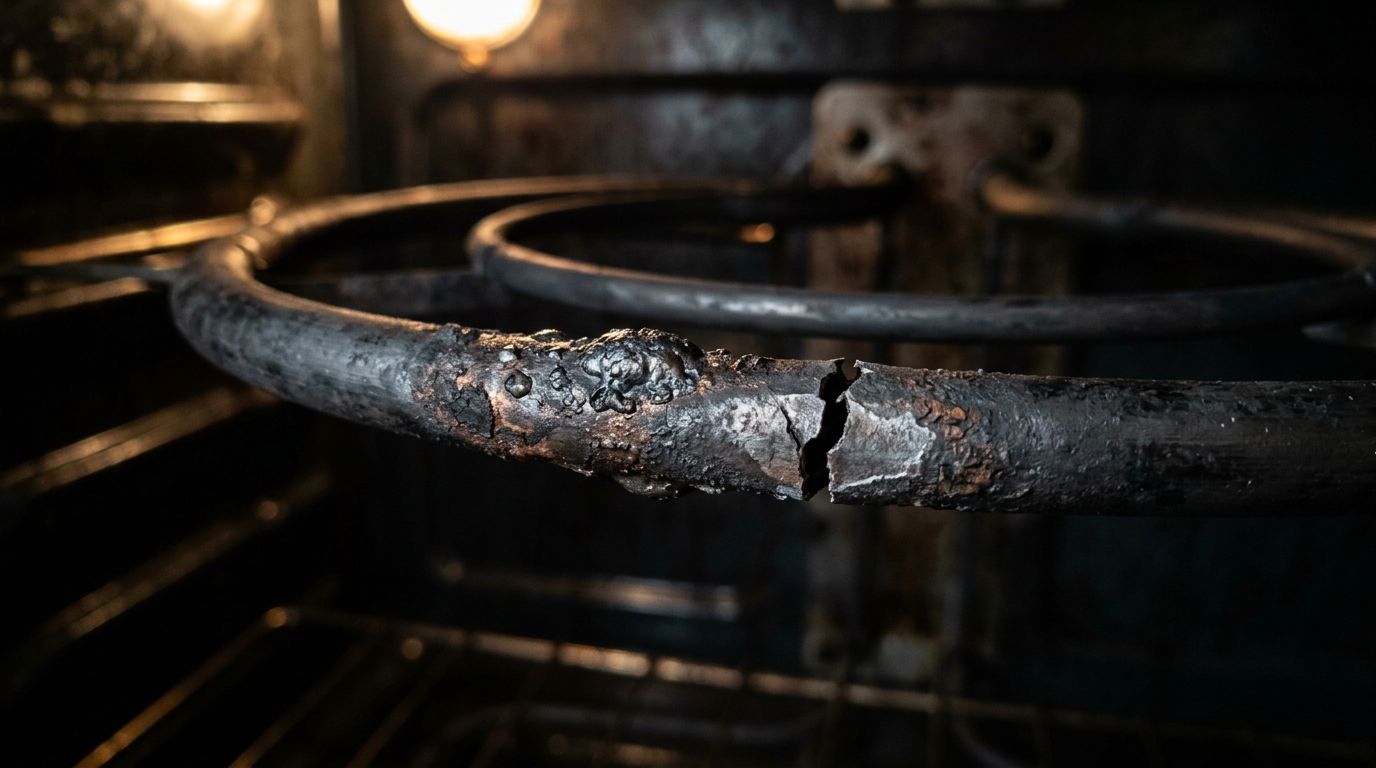 You can also test an element for electrical continuity using a multimeter. No continuity reading means the element is done. This is one of the more DIY-friendly repairs – the element usually connects to two terminal screws, and most replacements for common brands like Whirlpool, GE, Kenmore, and Frigidaire run between $25 and $75 for the part. That said, working inside an oven that runs at 240 volts requires care, and if you’re not comfortable with electrical work, this is a reasonable job to hand off.
Examine the igniter (gas ovens)
Gas oven not getting hot? Watch the igniter when you turn the oven on. It should glow bright orange within about 90 seconds and then the burner should light. If it glows but the gas doesn’t ignite, the igniter is probably too weak to open the gas valve – a common failure mode. If it doesn’t glow at all, the igniter has failed completely. A dirty igniter can sometimes be cleaned following your owner’s manual instructions, but a failed igniter needs to be replaced by a professional. Gas components aren’t something to improvise with.
Check the door seal
The gasket around your oven door is easy to overlook. If it’s torn, compressed flat, or pulling away from the door frame, heat escapes and the oven struggles to hold temperature. This creates a situation where the element or burner is working fine but the oven reads cold or cooks unevenly. Run your hand around the door seal while the oven is warm – if you feel heat escaping around the edges, the seal needs replacing. Gaskets are inexpensive and usually straightforward to swap out.
Check the temperature sensor
The temperature sensor is a thin probe, usually mounted in the upper back corner of the oven cavity. It needs to sit at a 90-degree angle and must not be touching the oven wall or any element. If it’s been knocked out of position, or if a heating element has shifted close to it, you’ll get inaccurate temperature readings – the oven might stop heating before it reaches your set temperature, or overshoot and burn everything. Repositioning a displaced sensor is a simple fix. If the sensor itself has failed, it will need to be replaced.
When the thermostat is the real problem
Here’s one that catches people off guard. Your oven heats up, the preheat light comes on, but food is consistently burning on the outside while staying raw in the middle. Or everything takes 30 percent longer than the recipe says. These are classic signs of a failing thermostat, not a dead element. The thermostat’s job is to read the internal temperature and signal the heating element or burner to cycle on and off to maintain your set temperature. When it starts to fail, it might read the temperature too high and cut off heating too early, leaving the oven cold. It might read too low and leave the heat running, scorching everything. It might just fluctuate unpredictably, which is especially noticeable when baking. A quick way to check: put an oven thermometer inside and compare it to your dial setting. If you set 350°F and the thermometer reads 280°F or 420°F consistently, the thermostat is likely off. Some thermostats can be recalibrated – many modern ovens have a calibration offset setting in the controls menu – but a thermostat that’s genuinely failing needs to be replaced. This is a job for a technician. One thing worth noting for homeowners in older neighborhoods like Hatzic or Silverdale: homes in those areas often have ovens that are 15 or 20 years old, and thermostat wear is very much an age issue. The older the oven, the more likely the thermostat is contributing to problems.
Gas vs. electric – what’s different about each
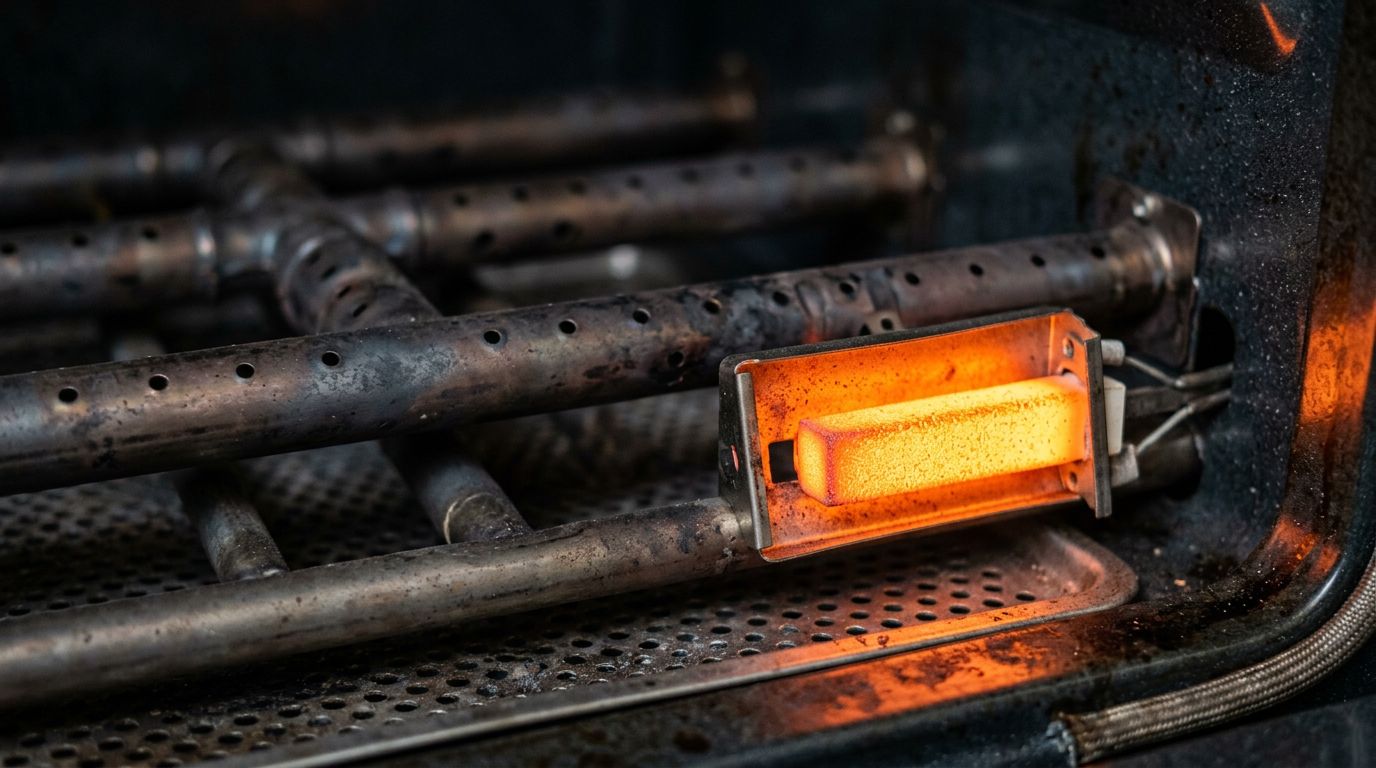 The troubleshooting steps overlap quite a bit, but there are real differences in how gas and electric ovens fail. Electric ovens are generally simpler from a components standpoint. The main things that go wrong are the bake element, the broil element, the temperature sensor, and the control board. Electric oven repairs are usually less expensive, with a typical heating element job running $100 to $250 including labor. The 240-volt circuits involved are still dangerous, but the repair process is fairly predictable. Gas ovens have a few extra layers. The igniter, the gas valve, the burner tube, and the thermocouple all play a role. Gas oven repairs can run higher – up to $600 if the problem involves more than just the igniter – partly because of the safety requirements around working with gas appliances. If you ever smell gas coming from your oven, don’t troubleshoot it yourself. Turn off the gas supply, ventilate the area, and call a professional. That’s not a DIY situation under any circumstances. There’s also the question of whether the oven is connected to a functioning gas supply. Sometimes what looks like an oven problem is actually a supply issue – a partially closed valve, a problem with the meter, or a service interruption. Worth checking before you assume the oven itself has failed.
Repair or replace – how to decide
Honestly, this is where a lot of people get stuck. The repair quote comes in and suddenly you’re second-guessing whether it makes more sense to just get a new oven. Here’s a practical way to think about it. If your oven is under 10 years old and the repair involves a single component – heating element, igniter, temperature sensor – repair almost always wins. Parts for common residential brands cost between $25 and $200 depending on the model, and labor brings a typical job to $150 to $400 all-in. That’s a fraction of what a new oven costs, which starts around $600 for a basic freestanding model and can easily reach $1,300 or more. The math shifts when the oven is over 15 years old or when multiple things are failing. If you’re looking at a control board failure on top of a bad element, and the oven is 18 years old, the repair cost can approach or exceed half the price of a comparable new unit. At that point, replacing makes more sense – partly for cost, partly because an aging oven is likely to need another repair within a year or two anyway. A reasonable rule: if the repair estimate exceeds 50 percent of what a comparable replacement oven would cost, take a hard look at replacement. If it’s well under that threshold, fix it. One more thing to check before you do anything: look up your oven model online to see if any recalls or class-action complaints have been filed. In some cases, manufacturers will cover repairs outside the standard warranty period if enough customers have reported the same problem. It takes five minutes and could save you the full repair cost.
Frequently asked questions
These are the questions we hear most often from homeowners in Mission dealing with oven problems. If your situation isn’t covered here, give us a call – sometimes a quick description of what’s happening is enough to point you in the right direction.
Why is my oven heating up but not baking food properly?
If the oven gets hot but food isn’t cooking right, the problem is usually the temperature sensor or thermostat rather than the heating element itself. Put an oven thermometer inside and check whether the actual temperature matches what you’ve set. A difference of more than 25 degrees suggests a calibration or sensor issue. Uneven baking – food done on one side but raw on the other – can also point to a failed element that’s only partially working, or a broken door seal letting heat escape unevenly.
Can I replace a heating element myself?
For a basic electric oven with an accessible bake element, yes – many homeowners can handle this with a screwdriver and a replacement part ordered from the manufacturer or a parts supplier. The key safety step is disconnecting power completely before you touch anything. Unplug the oven or switch off the circuit breaker, then confirm power is off. If the wiring looks complicated, the terminals are corroded, or you have any uncertainty, stop and call a technician. The repair is cheap to do right and expensive to do wrong.
How much does oven repair typically cost?
Most residential oven repairs fall between $150 and $400, including parts and labor. A straightforward heating element replacement on a common brand sits toward the lower end. More complex repairs – gas valve issues, control board failures, thermostat replacement on an older model – can push toward the higher end or beyond. Parts alone for standard heating elements generally run $25 to $75 for most brands. If someone quotes you significantly above $400 for a single-component repair on a standard residential oven, it’s worth getting a second opinion.
Is it safe to use an oven with a damaged heating element?
No. A visibly damaged element – cracked, blistered, or burned through – can arc, spark, or cause a fire. Don’t use the oven until the element is replaced. The same applies to a gas oven with a faulty igniter: if you can smell gas building up without the burner lighting, you have a potential hazard that needs to be addressed before the oven is used again. According to the National Fire Protection Association, cooking equipment is the leading cause of home fires – a damaged oven component isn’t worth the risk.
How do I know if my oven’s door seal needs replacing?
Run your hand around the door frame while the oven is at temperature. Any heat escaping from the edges means the seal is compromised. You can also close the oven door on a piece of paper – if you can pull the paper out easily, the door isn’t sealing tightly. A worn or torn gasket is an inexpensive fix, usually well under $50 for parts, and it makes a real difference in how evenly and efficiently the oven heats. Homes around Stave Falls tend to have older appliance stock where gasket wear is a common find.
What if my oven isn’t turning on at all?
Start with the circuit breaker. A 240-volt oven circuit that trips will leave the oven completely dead. Reset the breaker and try again. If it trips again, call an electrician – don’t keep resetting it. If the breaker is fine, check that the outlet itself is functional and shows no signs of damage. If power is reaching the oven but nothing happens, the problem is likely inside the oven’s control board or wiring, which needs a technician to diagnose properly.
Wrapping up
Most oven heating problems come down to a short list of suspects: the heating element or igniter, the temperature sensor, the door seal, or the circuit breaker. Start with the easy checks, work through them in order, and you’ll often find the answer before spending a dollar on parts. When repair does make sense – and for most ovens under 15 years old, it usually does – a professional diagnosis gets you a clear answer quickly and avoids the guesswork of replacing parts that don’t need replacing. At Dewdney Appliance Repair, we handle oven repair in Mission and the surrounding area regularly, and we’re straightforward about whether a repair is worth doing or whether you’d be better off putting that money toward a replacement. If your oven isn’t heating properly and you’d rather not spend your weekend troubleshooting it, give us a call – we’ll take a look and tell you exactly what’s going on.
