
Your appliance just stopped working, and now you’re staring at it wondering whether to call a repair tech or start browsing for a new one. This guide will help you think through that decision clearly, so you don’t overspend on a repair that buys you six months, or toss out a machine that had years of good use left. Most homeowners in Mission face this exact situation at least a few times. Appliances don’t last forever, but they don’t always need to be replaced the moment something goes wrong either. At Dewdney Appliance Repair, we talk to homeowners every week who aren’t sure which way to go, and honestly, the answer isn’t always obvious. The Fraser Valley climate, with its damp winters and hard water in some areas, can be tough on appliances over time, which makes regular maintenance and smart repair decisions even more worth thinking through.
Key takeaways
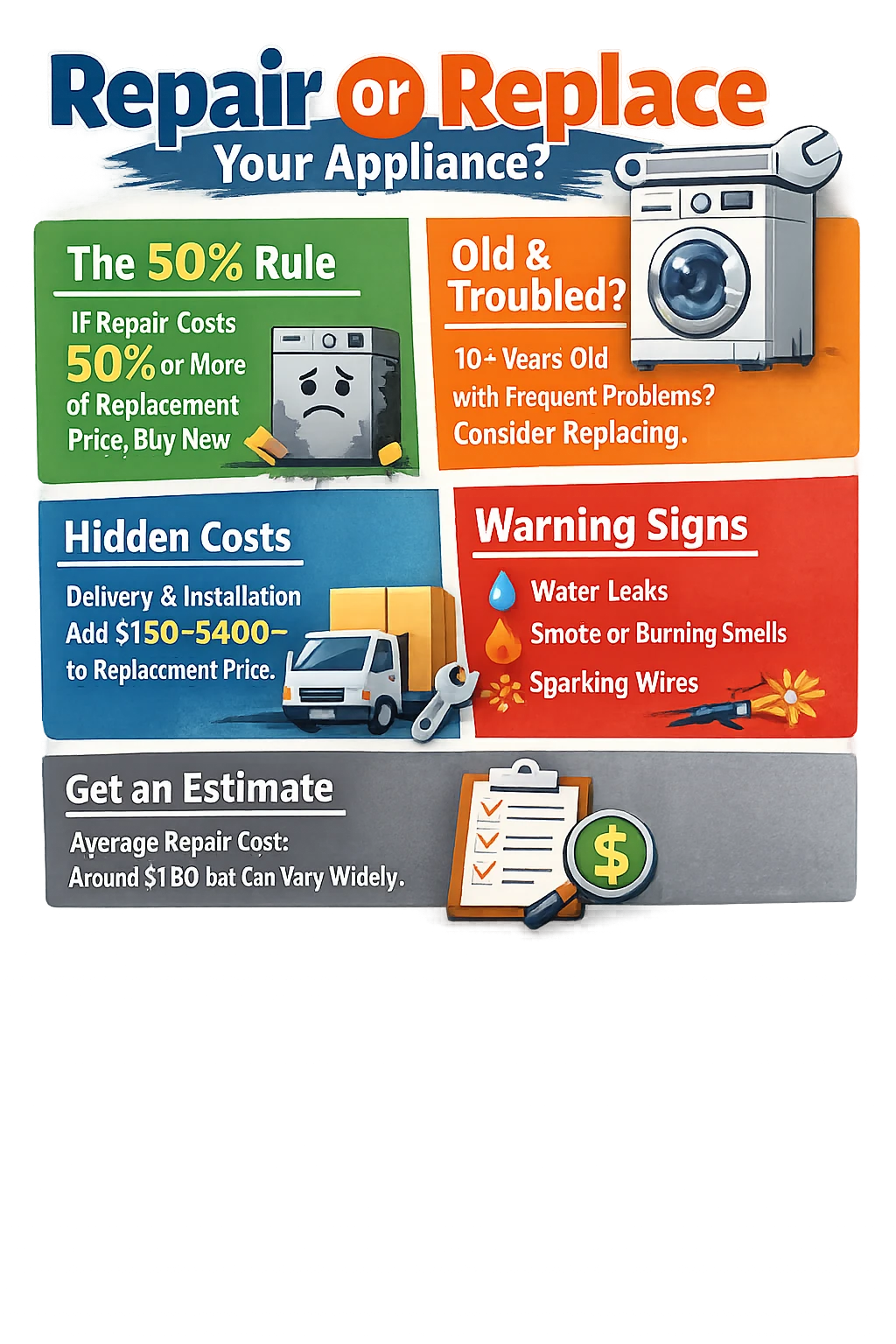
- If a repair will cost 50% or more of what a replacement would cost, buying new is usually the better call.
- Appliances that are 10 years old or older are generally candidates for replacement, especially if they’re showing multiple problems.
- A machine that was running well before a single thing broke is usually worth fixing.
- Hidden costs of replacement, including delivery, installation, and disposal of the old unit, can add $150 to $400 or more to the total price of going new.
- Parts availability matters, especially for older models, because a repair is only as good as the part you can actually get.
- Water leaks, smoke, burning smells, and sparking are warning signs that lean toward replacement, not repair.
The basic rule most repair techs use
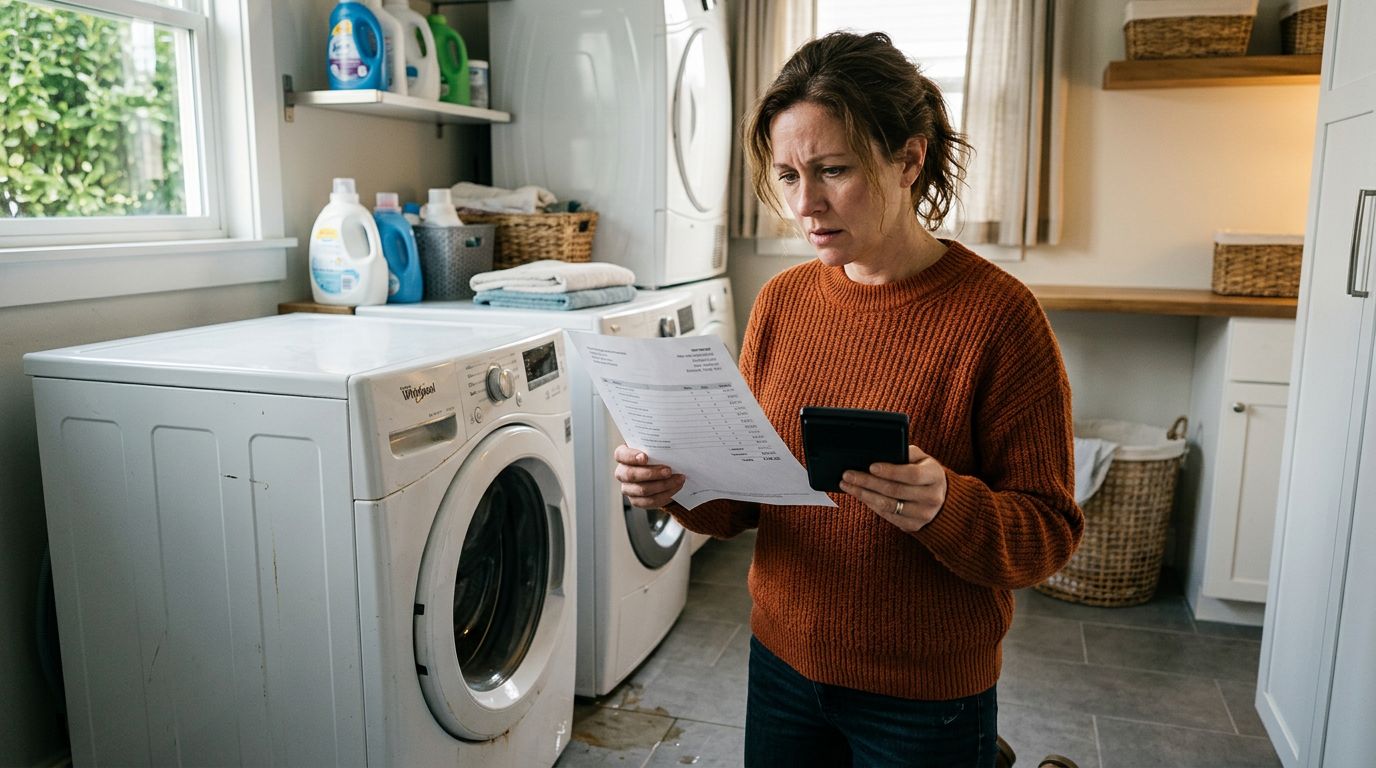 The most practical starting point is the 50% rule. If repairing the appliance will cost you 50% or more of what a comparable new one would cost, replacement is typically the smarter move. If the repair comes in under that threshold, fixing it usually makes more financial sense, assuming the appliance is otherwise in decent shape. That said, age changes the math. A repair that costs 40% of replacement on a 12-year-old dishwasher is a different calculation than the same repair on a four-year-old one. Older machines have other parts that are aging too, and what breaks today might not be the last thing that breaks this year. We see this pattern fairly often: someone pays for one repair, then three months later needs another one on the same unit. The other thing worth knowing is that the average appliance repair runs around $180, though that varies quite a bit by appliance type and what’s actually wrong. Before you make any decision, get an accurate estimate. A good technician will tell you what’s wrong, what it costs to fix, and what condition the rest of the machine is in. That last part matters as much as the repair price itself.
Average appliance lifespans worth knowing
 Knowing roughly how long an appliance should last helps you calibrate your decision. These aren’t hard ceilings, but they’re reasonable benchmarks: Dryers typically last 10 to 13 years. Washing machines run about 10 to 14 years, though front-loaders tend to wear out a bit sooner than top-loaders. Dishwashers generally make it 10 to 15 years. Refrigerators average 10 to 15 years depending on the type. Side-by-side models tend to have shorter lifespans than top-freezer styles. Stoves and ranges last 10 to 15 years. Microwaves are closer to 9 years. Garbage disposals sit around 5 to 10 years. These numbers assume reasonable maintenance and average use. A well-maintained appliance from a quality brand can significantly outlast these ranges. We’ve seen washers in Hatzic and Silverdale homes push well past the 15-year mark when they’ve been cared for. On the other hand, an appliance that’s been overloaded, rarely cleaned, or has had a rough history may not reach average lifespan at all. One detail that often surprises people: newer appliances are more feature-rich, but they’re also more complex. More components means more things that can eventually fail, and some of those components, particularly electronic control boards, can be expensive to replace. A 25-year-old top-load washer with basic mechanical parts can often be fixed cheaply. A five-year-old smart washer with a failed control board might cost more to repair than you’d expect.
When repair is the clear choice
Some situations make the repair decision straightforward. If your appliance is still under warranty, repair is almost always the right call. The manufacturer should cover the fix, and the machine is almost certainly within a reasonable portion of its useful life. If the appliance was working well right up until something specific went wrong, that’s a good sign. A single failed component, a heating element in a dryer, an inlet valve on a washer, an igniter on a gas range, doesn’t mean the whole machine is deteriorating. It means one part wore out. Replacing that part and getting years of continued use is exactly what repair is for. Repairs also make sense when you like the appliance and it does the job well. People sometimes underestimate how frustrating it can be to adapt to a new machine, especially if the replacement turns out to have quirks the old one didn’t. If your current appliance fits your household’s needs, keeping it going is a reasonable goal. There’s an environmental side to this too. Appliances contain materials that don’t belong in a landfill, and manufacturing new ones has its own footprint. Squeezing more years out of a working machine is genuinely the more sustainable choice, assuming the repair cost makes sense. A $200 repair that gets you another eight years of use is hard to argue against on any front.
When replacement makes more sense
If the appliance is near or past its expected lifespan and showing multiple issues, repair starts to look like a losing game. One homeowner’s experience captures this well: a 32-year-old washer that had been repaired over Christmas started flooding the house a few months later. The parts were available, but the overall condition made it clear that more failures were coming. At that point, replacement is the practical choice. Performance problems unrelated to the current repair are a red flag. If your washing machine isn’t cleaning clothes properly, or your fridge isn’t holding temperature the way it should, and you’re also dealing with a separate breakdown, the repair won’t fix those background issues. You’d be spending money to return the appliance to a state that wasn’t fully satisfactory to begin with. Energy efficiency is worth factoring in, though it shouldn’t be overstated. Newer refrigerators use roughly half the energy of older models, and that difference adds up over several years. If you’re running an old energy-heavy appliance and your electricity bill reflects it, replacement math can shift in favor of going new. That said, the environmental and financial cost of manufacturing and shipping a new appliance has to be weighed against the efficiency gains. Some specific warning signs lean strongly toward replacement: smoke coming from a dryer, rust on the inside of an oven, a refrigerator compressor that’s stopped running (that’s typically a $500 repair on its own), a washer that won’t spin and requires near-complete disassembly to fix. These situations tend to put repairs well past the 50% threshold.
The hidden costs of buying new
A lot of homeowners compare the repair estimate to the sticker price of a new appliance and call it even. That’s not the whole picture. Delivery and installation add real money. A new dishwasher at $300 with a $175 installation fee is actually a $475 purchase. Some appliances require new hookups or wiring upgrades, especially in older homes. Older houses in neighbourhoods like Hatzic Prairie sometimes need electrical work before a modern appliance can be installed safely. Hauling away the old unit costs something too, unless you have a truck and a friend available. None of this makes replacement the wrong choice. It just means you need to use the real total cost when you’re comparing options, not just the shelf price. A repair that costs $220 looks different next to a $900 total replacement cost than it does next to a $500 appliance price alone.
Appliance-by-appliance considerations
Different appliances come with different repair logic.
Refrigerators
Fridge repair vs replace decisions hinge heavily on what broke. Minor issues, a failed door seal, a faulty ice maker, a broken shelf mechanism, are usually worth fixing. A failed compressor is a different story. Compressor repairs are expensive and labor-intensive, and if the fridge is older, it may not be worth the investment. For a newer, high-end refrigerator, a $300 to $400 repair still makes sense. For a 14-year-old basic model, probably not.
Washing machines and dryers
Washing machine repair versus replacement often comes down to which type you have and what broke. Top-loaders with mechanical components are generally simpler and cheaper to fix. Front-loaders can be more complex, and drum bearing replacement in particular is a labor-heavy job. If you’ve replaced the bearings twice already, that’s a sign the machine is telling you something. Dryers are generally the most repair-friendly appliance in the house. Heating elements, thermostats, belts, rollers – these are relatively straightforward repairs and parts are widely available. A dryer in otherwise good shape is almost always worth fixing unless it’s well past its lifespan or showing serious structural issues.
Dishwashers
Dishwasher repair or replacement tends to favor replacement once the machine passes the 12 to 15-year mark and develops leaks or motor issues. A 25-year-old dishwasher that starts leaking around the door and getting loud has done its job. Replacing the door gasket might solve one problem while leaving others in the queue. For newer dishwashers with a specific part failure, repair is almost always the better call.
Ovens and stoves
Oven repair is often quite straightforward. An 18-year-old gas range with a failed igniter is a good candidate for repair, especially if a technician inspects the rest of the unit and finds it in solid condition. You avoid the cost and hassle of a new range, and the machine has demonstrated it can last. Rust on oven walls is a different matter, as that kind of deterioration is expensive to properly address.
Smaller appliances and specialty items
For garbage disposals, microwave repair, range hood repair, and bathroom fan repair, the calculus tends to favor replacement more quickly because these units are relatively inexpensive to buy new. A garbage disposal that’s failing at 8 years old and costs $150 to repair might be better replaced for $200 to $250 total. For bathroom fans and range hoods, the parts and labor to repair an aging unit can easily approach or exceed replacement cost.
Frequently asked questions
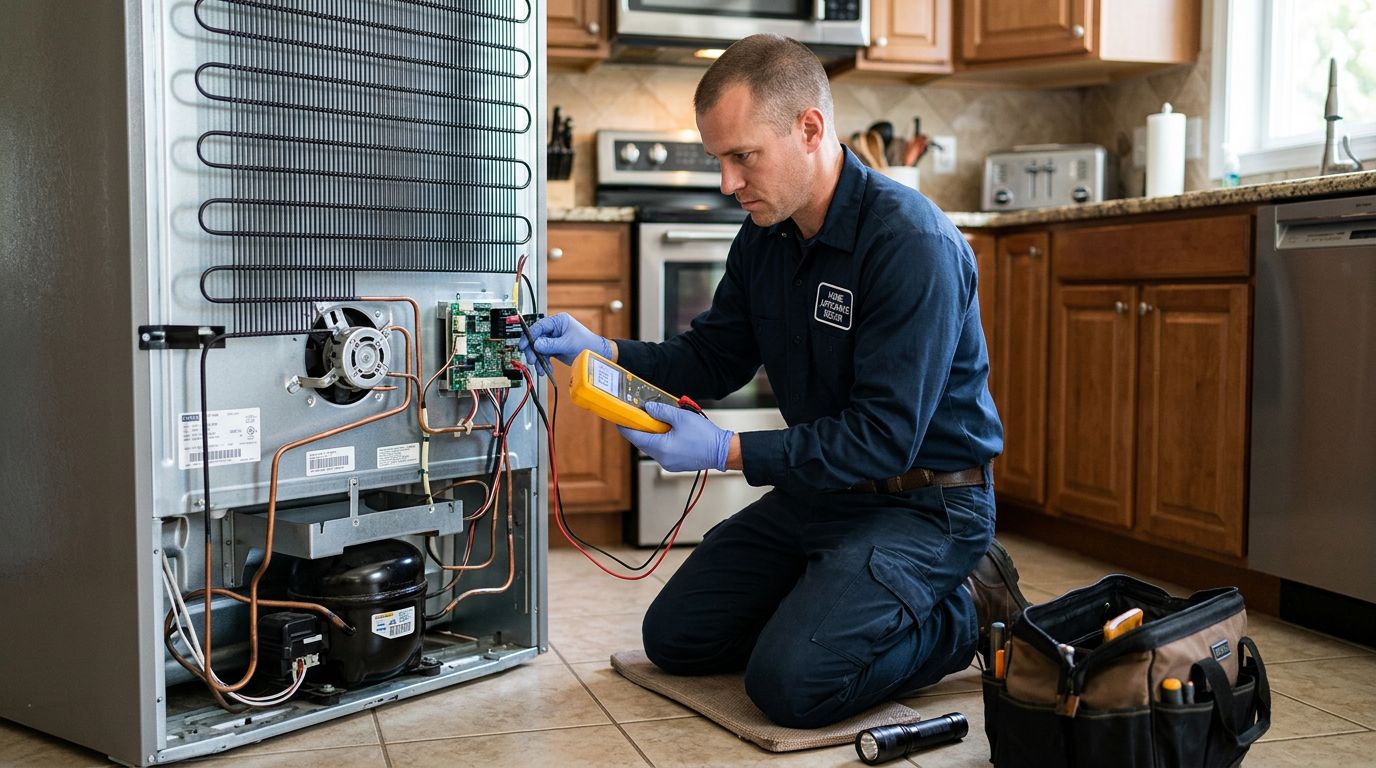 Before calling a technician or heading to an appliance store, these are the questions we hear most often. Getting clear on these can save you time, money, and a second-guess session at the checkout.
What is the 50% rule for appliance repair?
The 50% rule means that if fixing your appliance will cost 50% or more of the price of buying a comparable replacement, you’re generally better off replacing it. For example, if a new washing machine costs $700 and a repair quote comes in at $380, you’re over the threshold and replacement deserves serious consideration. The rule works best when combined with the appliance’s age. A costly repair on a two-year-old machine is very different from the same repair on a 12-year-old one.
Does the age of an appliance really matter that much?
It matters a lot. Around the 10-year mark, most appliances start showing more frequent problems, and the likelihood of additional failures increases. Parts can also become harder to find as models age out of production. A repair that solves today’s problem on a 13-year-old appliance might just delay the next breakdown by a few months. That doesn’t mean you never repair older appliances – plenty of well-maintained machines keep running strong past 15 years – but age should factor into your decision alongside repair cost.
Are there signs I should replace instead of repair right away?
Yes. Smoke or burning smells from any appliance, sparking in a microwave, a refrigerator that’s leaking water, a fridge compressor that’s completely stopped – these situations tend to lean toward replacement. Water leaks in general are a common final straw. A machine that’s leaking has often deteriorated in ways that go beyond a single fixable part. Unusual noises, spiking utility bills, and consistently poor performance are also worth taking seriously, even if they don’t feel urgent on their own.
Is it worth getting a professional estimate before deciding?
Almost always, yes. Making the call to replace without knowing the actual repair cost often leads to spending more money than necessary. A diagnostic visit gives you concrete numbers to work with. Some repair companies offer free inspections. Even when there’s a service fee, it functions like a second opinion at the doctor – you’re paying for information that helps you make a smarter decision, not just committing to the repair.
What about DIY repairs?
For the right person and the right job, DIY can save real money. Replacing a dryer belt, cleaning a washer pump filter, swapping out an oven igniter, clearing a dishwasher drain – these are tasks many homeowners can handle with some research and patience. YouTube has genuinely transformed what’s accessible to a motivated DIYer. That said, anything involving gas lines, refrigerant, or electrical rewiring is not a DIY job. The risk isn’t just voiding a warranty – it’s safety. Know your limits, and when in doubt, call someone who works on these things every day.
Wrapping up
The repair vs replace appliance decision isn’t one-size-fits-all, but it’s also not as complicated as it can feel in the moment. Start with the 50% rule, factor in the appliance’s age and overall condition, and make sure you’re comparing the repair cost against the real total cost of replacement, not just the sticker price. A machine that was running well before a single thing broke is usually worth fixing. One that’s been struggling and is closing in on the end of its expected lifespan probably isn’t. If you’re in Mission or the surrounding area and you’re not sure which way to go, Dewdney Appliance Repair can help you think it through. We handle a wide range of repairs across the region and we’ll give you an honest assessment of what’s wrong and whether fixing it makes sense. Give us a call before you make any decisions, and we’ll help you figure out the best path forward.
